
UH OHHHHH ...
Quentin Tarantino and Soft White Power

Every year, I start off with the best intentions to try and focus my movie-watching on as many new-to-me titles as possible - I was on a roll this time last year till the LA Fires sent me running to the self-soothing comfort of old favorites. Like that resolution to hit the gym more, I tend to focus on pulling new-to-me’s from the Criterion Channel, an incredible resource for the nourishment of more challenging fare and a trove of “I should have watched this before.”
Already this year, I’ve hit The Battle of Algiers1 and Megadoc2 (on one very long flight, no less), and then rolled right into Lady Snowblood3, which I can’t believe it’s taken me this long to get to.
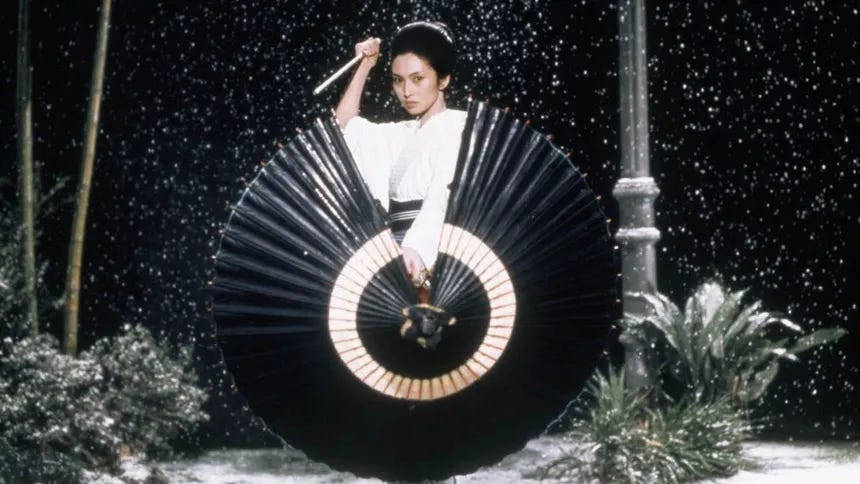
Lady Snowblood tells the story of Yuki (Meiko Kaji) - trained in martial arts and swordplay by a pitiless master to pursue a one-by-one revenge quest - bequeathed by the mother (Miyoko Akaza) who died giving birth to her - in which she runs afoul of the daughter of one of her victims, and if any of this is starting to sound familiar, yeah, it’s one of Tarantino’s huge influences on the massive syllabus that forms Kill Bill4.
Tarantino’s been in the news lately for gracelessly coming after Paul Dano, an actor Tarantino’s never worked with, for a performance Tarantino found weak, in a movie Tarantino didn’t make. I’m not trying to wade into that whole mess, beyond the context of a state-of-the-union for how we’re all feeling about Tarantino these days, and short version … not great?
So not to dogpile on that sentiment, but as I watched (and was blown away by) Lady Snowblood, I got caught in the intellectual cul de sac I usually do when engaging with the original of something where I’m more familiar with the homage; how (or if) to stay enjoying the homage even as elements I took for original are revealed as copies, however lovingly rendered.
And for the record: I don’t have a problem with homage; I have a problem with bad homage. I thought Stranger Things5 was at its comparative strongest while trawling its own waters, instead of reminding me of the far-better-executed originals. But then … Stranger Things was meant ideally for people younger than me, who didn’t experience E.T. or The Goonies or The Thing or Stand By Me the first time around, much like I didn’t experience Lady Snowblood or The Great Silence or Gone In Sixty Seconds before being exposed to their touchpoints in Kill Bill, so I get it.
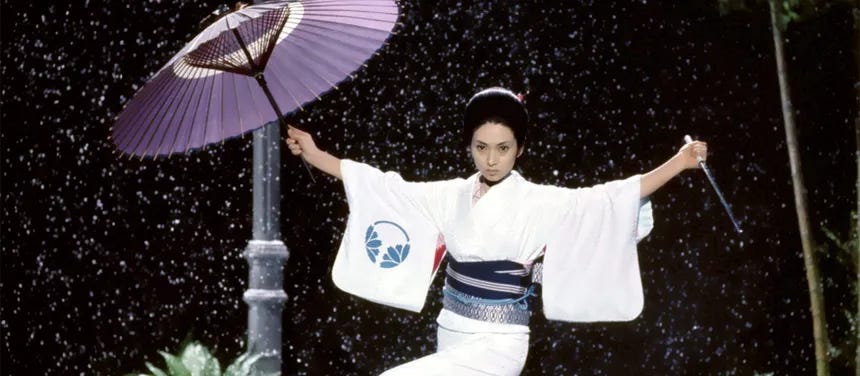
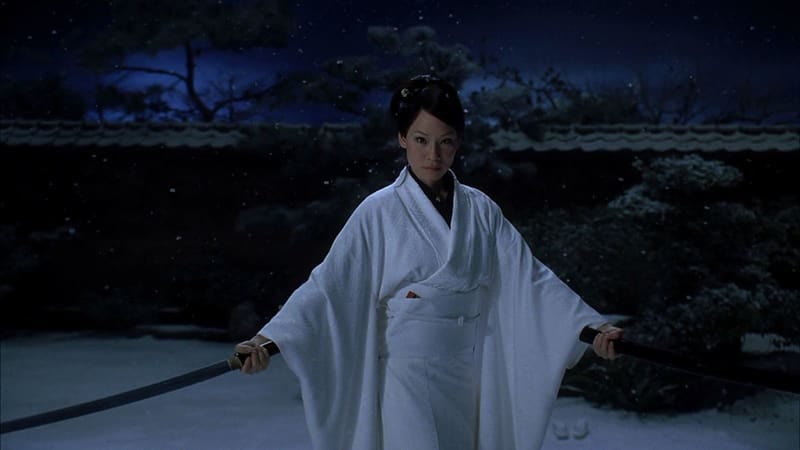
So while the visual similarities - katana fights in falling snow, Kaji’s entire esthetic being applied to Lucy Liu’s O-Ren Ishii - were impossible to miss, Kill Bill is so deeply reverent and loving in its recreations of Tarantino’s favorites … up to a point.
See, as I chased my thoughts, I accidentally tripped over onto the frequency that Quentin Tarantino’s … kinda racist.
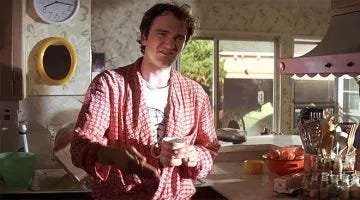
No, I know, stop the presses, the southern semi-literate late-Boomer enfant terrible with the n-word fetish might be a little on the problematic side. And while I’d never excuse his excessive n-word use, I understand he’s using it to demonstrate that these aren’t good people. … I think.
BUT. Like anybody, the man has blindspots where he’s stayed unreconstructed (again, I know, the late-boomer who’s been celebrated for being him since he was 30 hasn’t grown and changed, alert the media), and a big one laid itself bare to me watching Lady Snowblood.
As I watched Kaji hack her way through scenes that inspired Kill Bill, my mind wandered to Al Pacino’s monologue early in Once Upon a Time in Hollywood:
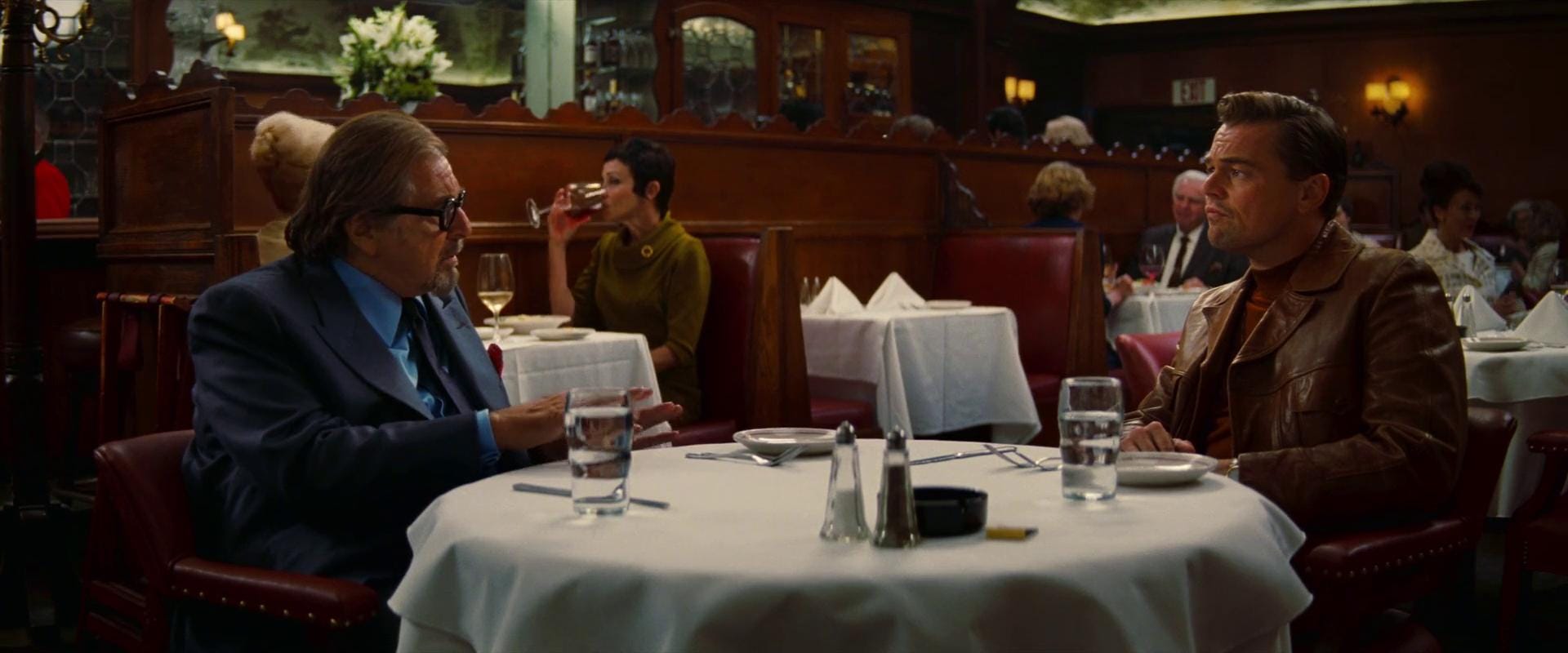
Oh, that’s an old trick pulled by the networks. Now, you take Bingo
Martin, for example. Right? So you got a new guy like Scott Brown.
You wanna build up his bona fides, right? So you hire a guy from a
canceled show to play the heavy. Then at the end of the show, when
they fight, it’s hero besting heavy. But what the audience sees… is Bingo
Martin whipping Jake Cahill’s ass. You see? Then next week, it’s Ron Ely.
And next week, it’s Bob Conrad, wearing his tight pants, kicking your ass.
Yeah. Now, in another couple of years, playing punching bag to every
swinging dick new to the network, that’s gonna have a psychological
effect on how the audience perceives you. So Rick, who’s gonna kick
the shit out of you next week? Mannix? The Man from U.N.C.L.E.?
The Girl from U.N.C.L.E.? How about Batman and Robin? Ping!
Pow! Choom! Zoom! Down goes you, down goes your career as a
leading man.
Which in turn reminded me that, with this monologue, Tarantino’s letting us in on the joke so that later when we see Cliff Booth (Brad Pitt) beat up Bruce Lee (Mike Moh), it’s to set us up to know that Cliff has hands when it matters later on. But also … it’s a white guy beating up Bruce Lee.
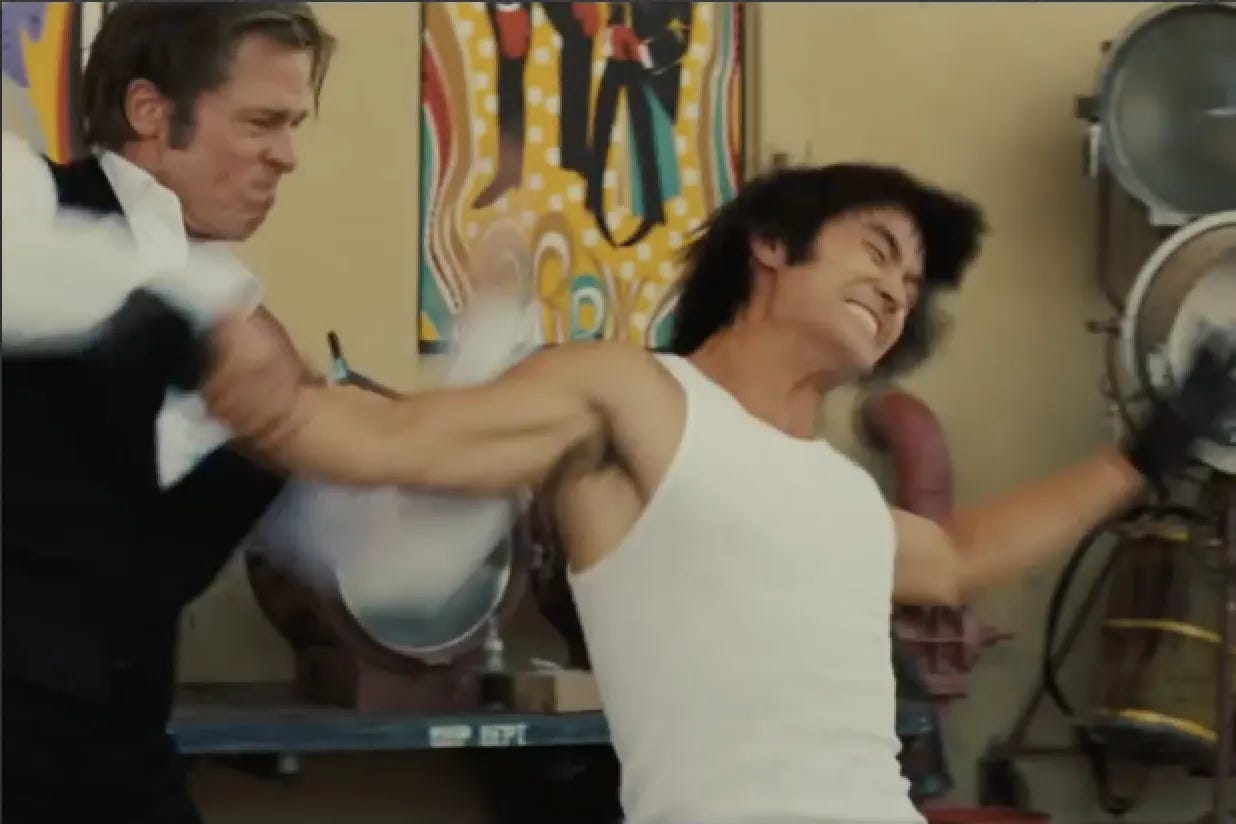
Yes, it’s a fictitious Bruce Lee, presented here as a preening loud-mouth, putting Cliff in the position of shutting his big mouth for him (a righteous, masculine position in the Tarantino cosmology), but … it’s three-decade movie star Brad Pitt, winning an Oscar for beating the shit out of Bruce Lee. The optics aren’t great, and it’s been a sore spot for a growing segment of the movie’s audience over the course of its lifespan.
But it’s not the first time Tarantino’s played that card - just the first time he’s told us he’s playing it; if O-Ren Ishii is a visual manqué for Lady Snowblood, but The Bride beats her in a duel, Tarantino’s saying, intentionally or not, “My Lady Snowblood can beat up your Lady Snowblood, and my Lady Snowblood is white.”
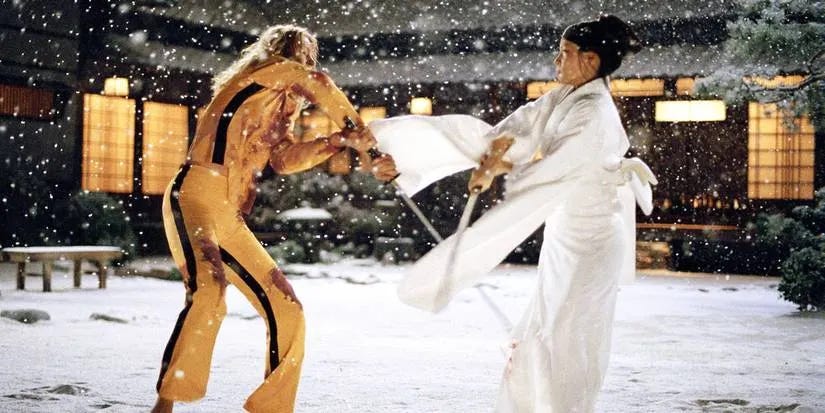
Much the same way that, with Kill Bill, he’s attempting not so much to kill his darlings like Leone or Corbucci or the Shaw Bros., but to show that he can beat them at their own game - he can make a better wushu movie than a Chinese filmmaker, a better jidaigeki than a Japanese filmmaker, a better Spaghetti Western than an Italian filmmaker.
And none of this should be shocking coming from a guy who’s such an open acolyte of Elvis - the “my Black singer can beat your Black singer and he’s white” apex predator - that he opens the script with his most glaring self-insert pontificating at length about how and why Elvis is the king.
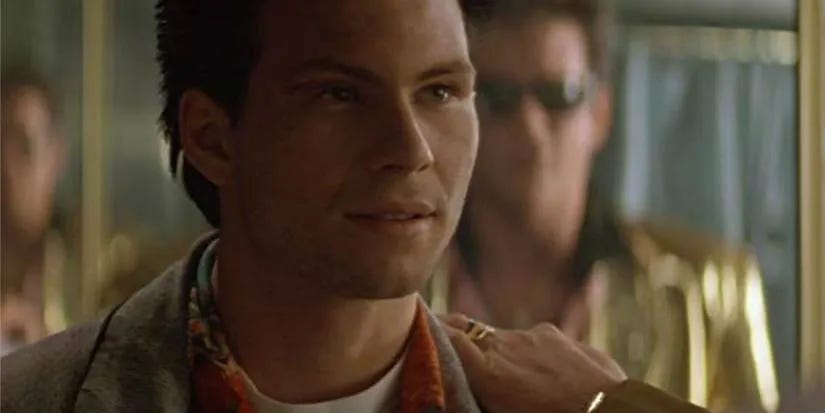
Now, do I think Tarantino’s out there committing hate crimes against minorities? I tend to doubt it. Do I think he has blindspots that favor white people? The proof is in 35 years of pudding.
And now that I’ve realized all of this … I have absolutely no idea what to do with it, except I guess share it with you. I tend to think cancellation has more to do with people’s actions and words in their personal lives than in their art - since the art you can just choose not to engage with.
Now I’ve gotta sit with this a minute, see how I feel whenever he gets around to his next movie.
The Battle of Algiers (La battaglia di Algeri; معركة الجزائ) - Dir: Gillo Pontecorvo; W: Screenplay by Franco Solinas; Story by Solinas & Pontecorvo; based on Souvenirs de la Bataille d’Alger by Saadi Yacef; Prod: Yasef, Antonio Musu; DP: Marcello Gatti; Ed: Mario Morra, Mario Serandrei; Composer: Ennio Morricone, Pontecorvo; Igor Film/Casbah Films/Allied Artists (1966).
Megadoc - Dir: Mike Figgis; DP: Figgis; Ed: Joe Beshenkovsky; Prod: James T. Mockoski, Tara Li-An Smith; Composer: Figgis; Utopia (2025).
Lady Snowblood (修羅雪姫; Shurayuki-Hime) - Dir: Toshia Fujita; W: Screenplay by Norio Osada; from the manga by Kazuo Koike, Kazuo Kamimura; Prod: Kikumaru Okuda; DP: Masaki Tamura; Ed: Osamu Inoue; Composer: Masaaki Hirao; Tokyo Eiga/Toho (1973).
Kill Bill - Dir: Quentin Tarantino; W: Tarantino, based on the character The Bride by Tarantino and Uma Thurman; Prod: Lawrence Bender; DP: Robert Richardson; Ed: Sally Menke; Composer: The RZA, Robert Rodriguez; Miramax (2003-04).
Stranger Things - Created by The Duffer Bros; Showrunners: Karl Gajdusek, The Duffer Bros; Prod: Lampton Enochs; 21 Laps/Monkey Massacre Productions/Upside Down Pictures/Netflix (2016-26)